
Is The White House Moving To Ban Proof Of Work?
In a recent report by the White House Office of Science and Techhttps://www.whitehouse.gov/wp-content/uploads/2022/09/09-2022-Crypto-Assets-and-Climate-Report.pdf, a worrying statement was included. The 37-page long document, which looked a
In a recent report by the White House Office of Science and Tech, a worrying statement was included.
The 37-page long document, which looked at the "climate and energy implications of crypto-assets in The United States", covered topics from the validity of Blockchain Technology, to the pollution caused by various cryptographic solutions.
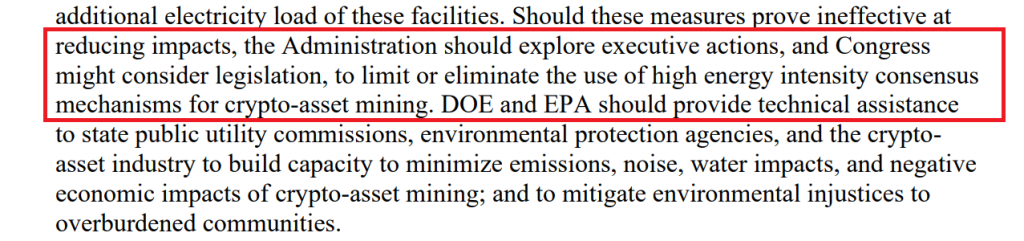
Image: page 7, White House Office of Science and Tech
While several positive aspects of blockchain technology and crypto-assets were covered, the worrying paragraph came towards the start:
"congress might consider legislation, to limit or eliminate the use of high energy intensity consensus mechanisms for crypto-asset mining."
This comes with the wider context of congress trying to minimize the environmental impacts of crypto-assets, and refers to the energy-intensive "Proof of Work" (PoW) consensus mechanism that is used by leading cryptocurrencies such as Bitcoin.
Also Read: Tornado Cash Sanctioned By U.S. Treasury After $7B Laundered
Crossroads
Despite a flurry of outraged comments by crypto participants, the White House does not seem to actively be moving to ban PoW.
https://twitter.com/DigitalAssetTax/status/1567876198583107584
Instead, they are at simply weighing out whether the pros of blockchain technology truly overshadow the environmental impacts it has.
"The potential benefits of [Distributed Ledger Technology] would need to outweigh the additional emissions.... there are potential positive and negative use cases yet to be imagined."
As such, it seems that the government is currently toying about with the idea of blockchain technology. Furthermore, they seem to imply that a ban would be a last resort, instead of something they are eagerly eyeing.
Benefits of PoW
While many market pundits may view crypto-assets as a gateway towards worthless JPEGS and ponzi schemes, the underlying technology has been employed heavily in the real world.
A recent study also showed that 22% of the US adult population owns Bitcoin or some other form of cryptocurrency.
Recognizing this, The United States seems to be encouraging such use cases, but with renewable energy instead.
"Crypto-Asset mining can be powered by stranded methane and renewables"
Furthermore, they acknowledge that Digital Asset Technologies could "support climate monitoring or mitigation", and be used in environmental markets.
While the initial headlines seemed to hint at a negative stance on crypto-assets and Proof of Work, a deeper dive into the report shows that The United States may instead be trying to push for more adoption, just in a greener way.
Also Read: Entering The Metaverse: DBS Partners With The Sandbox To Launch “DBS BetterWorld”
[Editor’s Note: This article does not represent financial advice. Please do your own research before investing.]
Featured Image Credit: DBS Bank
Get the Chain Debrief newsletter
Crypto & Web3 analysis, weekly.